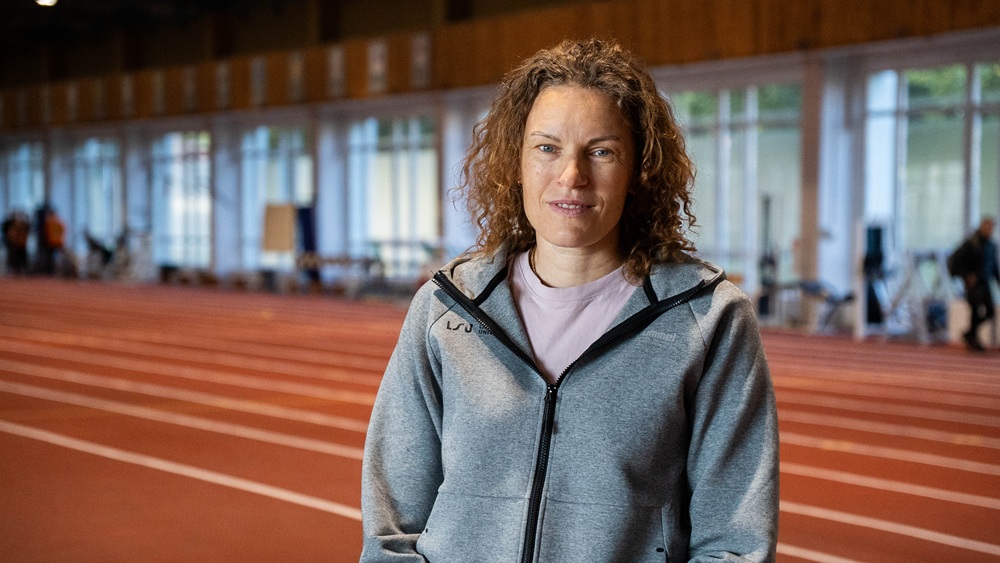
How can athletes push beyond their usual speed limits? Can running faster than their natural maximum speed improve sprint performance? These questions were at the heart of the doctoral research conducted by Austra Skujytė, a doctoral researcher at Lithuanian Sports University (LSU), who investigated overspeed sprint training and individual adaptations among athletes.
For Austra, this research was also a continuation of her professional journey. She had trained under renowned athletics coach Aleksas Stanislovaitis, whose idea of experimenting with assisted sprinting became the starting point for her future dissertation. Following the coach’s passing, Skujytė contributed to further developing the concept and refining the equipment before deciding to investigate it scientifically. In honour of her former coach, the system was named “Alex7” – seven was Stanislovaitis’ favourite number.
Her doctoral dissertation, “Enhancing Power Across Different Sprinting Speed Ranges: Individualisation Through Assisted Sprinting”, supervised by LSU Professor Dr Sigitas Kamandulis, first evaluated the validity and reliability of the motorised Alex7 system. The research then examined how assisted sprinting affects muscle activity and sprint biomechanics. In the training intervention, conducted with football players, Skujytė investigated the adaptations that such a training programme could produce.
The findings showed that assisted sprint training improves athletes’ ability to sprint under assisted conditions, but these improvements do not always translate into faster unassisted sprinting. This is an important message for coaches: achieving higher speeds during assisted training does not automatically guarantee better performance in competition.
The study also found that training-induced adaptations were related to athletes’ initial strength and speed characteristics. This suggests that assisted sprint training should not be viewed as a universal solution, but rather as a method that can help coaches individualise training programmes more precisely.
“New technologies allow us to control this process much more precisely than in the past, when athletes used elastic bands to pull one another during training. Today, we can control the assisting force, monitor the speed achieved and see how it changes at different points along the sprint distance. I believe this is a real eye-opener,” says Skujytė, highlighting the growing importance of technology in coaching.
The four-year research project not only provided new answers but also raised further questions. According to Skujytė, future studies could explore longer sprint distances, different assisted sprinting protocols and how improvements achieved during training can be transferred to regular, unassisted sprinting.
Skujytė’s research has contributed to a better understanding of the potential of assisted sprint training, while also demonstrating how modern sports training increasingly relies on individual data, advanced technologies and scientific evidence.