
Valdas Adamkus was born in Žaliakalnis, arguably one of the most beautiful neighbourhoods in Kaunas. He recalls that from his family home, located at the corner of V. Kudirkos Street and Gėlių Ratas, he could see the main building of our University, which at the time housed the Palace of Physical Education. As Adamkus was still a secondary school student, he was too young to attend the Higher Courses of Physical Education held in the building between 1934 and 1938. However, he would regularly run past the building on his way to the State Stadium, where he trained under some of the most renowned sports specialists of the time.
“My stepfather brought me my first football from England. Before that, my friends and I would kick around whatever we could find. We played football until dusk. Perhaps part of its appeal was that the sport received no attention at our school and was considered a game for hooligans,” the President recalled.
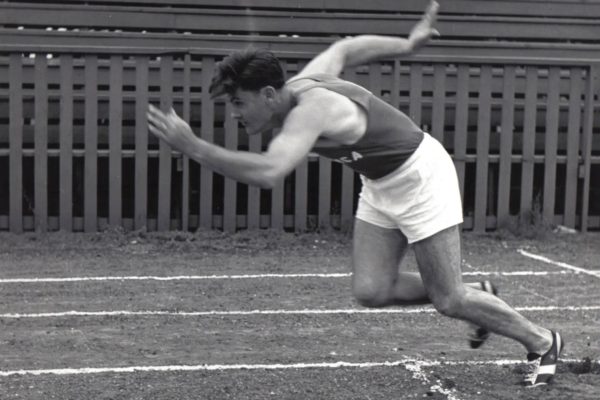
Adamkus trained in athletics at what was then the State Stadium, now the Darius and Girėnas Stadium. His coaches were athlete Vladas Bakūnas and physical education teacher Anupras Tamulynas, whom he regarded as his second parents. In 1941, Bakūnas, a renowned interwar sprinter, gave Adamkus a new pair of running shoes. Wearing them, the young athlete achieved his personal best results of 10.8 seconds in the 100 metres and 7.24 metres in the long jump.
During a visit to the renovated Darius and Girėnas Stadium in 2024, the President recalled how, as a young athlete, he used to dig his own starting holes in the stadium’s cinder running track.
His love of basketball began in 1937, when 11-year-old Valdas joined thousands of Kaunas residents at the city’s railway station to welcome Lithuania’s European basketball champions returning from Riga. Two years later, he witnessed Lithuania’s second European triumph in person.
Adamkus began playing basketball at Aušra Boys’ Gymnasium. His sporting idols included not only the Lithuanian national team that won the 1937 European Basketball Championship but also his older schoolmate Stepas Butautas, who later became an associate professor and long-serving lecturer at our University. By 1939, Adamkus had become an enthusiastic supporter of the Lithuanian men’s national basketball team, watching the matches of the third European Basketball Championship.
In May 1939, Kaunas was gripped by basketball fever. Kaunas Sports Hall, built specifically for the European Championship, attracted thousands of spectators, including 13-year-old Valdas Adamkus, the future President of the Republic of Lithuania.
Living near the Sports Hall, he watched its construction at close range and, once the championship began, tried not to miss a single match. Unable to afford tickets, he would slip into the venue by blending into the crowds of spectators. The President later recalled this childhood mischief with a smile, although he admitted that he was not proud of it.
His passion for basketball was so strong that it even overshadowed his preparations for the secondary school entrance examinations. However, the memories of Lithuania’s basketball triumph stayed with him throughout his life.
In 2023, during celebrations marking the 20th anniversary of Lithuania’s victory at the 2003 European Basketball Championship, Adamkus once again took part in a basketball celebration. He recalled witnessing Lithuania’s triumph in 1939 and, 64 years later, experiencing the joy of the 2003 victory, when the Lithuanian men’s national team became European champions for the third time.
Which Sports Did President Valdas Adamkus Practise?
While living in the United States, Adamkus enjoyed playing golf. Following the restoration of Lithuania’s independence, he became one of the early promoters of the sport in the country. He even advised Vytautas Motiejūnas, an Honorary Doctor of our University, on the design of the first nine golf holes.
President Adamkus was also known as a skilled recreational tennis player and enjoyed skiing in the mountains of Colorado. Swimming was another particular passion. Even during his presidency, a session in the swimming pool was often the first activity on his demanding daily schedule.
An Olympic Dream Without a State
Was President Valdas Adamkus involved in the Olympic movement? Absolutely.
At the age of 21, Adamkus, already a young sports organiser, was part of a Lithuanian delegation that appealed to the International Olympic Committee to allow Lithuanian athletes to participate in the 1948 Olympic Games in London.
Unfortunately, Lithuanian athletes were unable to secure the right to represent their occupied country. Nevertheless, together with representatives of other Eastern European nations, they organised the Games of the Captive Nations in 1948.
The Lithuanian flag at these Games was carried by Zenonas Puzinauskas, a member of Lithuania’s European championship-winning basketball teams of 1937 and 1939. The future President of Lithuania, Valdas Adamkus, also marched with the delegation.
His sporting achievements at the Games were remarkable: Adamkus won two gold and two silver medals.
Later, as President of the Republic of Lithuania, he attended the Olympic Games in Sydney, Athens and Beijing. The suitcase he took to the Sydney Olympics as an official member of the Lithuanian Olympic delegation is now exhibited at the Lithuanian Sports Museum.
Sport That United Lithuanians Around the World
From his youth and throughout his later career as a senior US government official and environmental protection specialist, Valdas Adamkus consistently worked to preserve and strengthen Lithuanian national identity.
After the Second World War, while living in Germany, he became involved with the Young Men’s Christian Association (YMCA). In 1947, he completed a sports instructor training course in Grafenau, Bavaria.
When he later arrived in the United States, his modest belongings were packed into a small YMCA staff bag. Among them were sportswear, a discus, football boots and his cherished running spikes, which he had worn during his victories at the Games of the Captive Nations.
Between 1947 and 1949, Adamkus worked for the Supreme Committee for Physical Education and Sport. In 1951, he became one of the founders of the Lithuanian academic sports club Lituanica in Chicago. He subsequently held leadership positions in Lithuanian sports organisations across North America.
In Marytė Marcinkevičiūtė’s book Valdas Adamkus – A Man of Sport, the President recalls the profound impression made on him by the Lithuanian National Olympiad held in the summer of 1938, which brought together Lithuanian athletes from around the world.
Perhaps inspired by this experience, Adamkus became one of the initiators of the World Lithuanian Games. Following extensive discussions, the Games were established as a continuation of the 1938 National Olympiad.
In 1983, Adamkus chaired the Organising Committee of the Second World Lithuanian Games in Chicago. Eight years later, he led the delegation of Lithuanian-American athletes at the Fourth World Lithuanian Games, which were held in Lithuania.
Valdas Adamkus and the Lithuanian Sports University
Following the restoration of Lithuania’s independence, President Valdas Adamkus actively contributed to shaping the country’s sports policy. Working alongside researchers and lecturers from the Lithuanian Sports University, he helped address some of the most pressing challenges facing the development of sport in Lithuania at the time.
Professors Stanislovas Stonkus, Aleksas Stanislovaitis and Kęstutis Miškinis regularly participated in discussions with President Adamkus, both at the Presidential Palace and at our University.
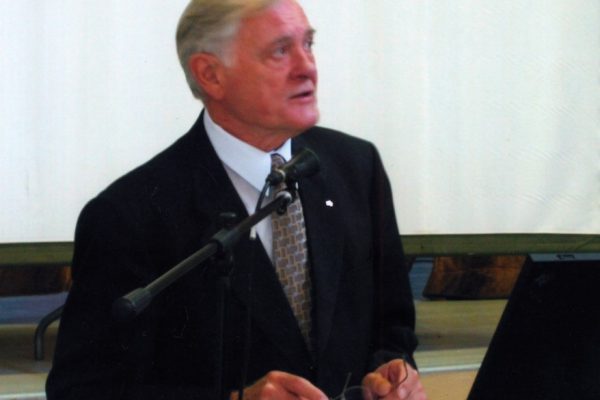
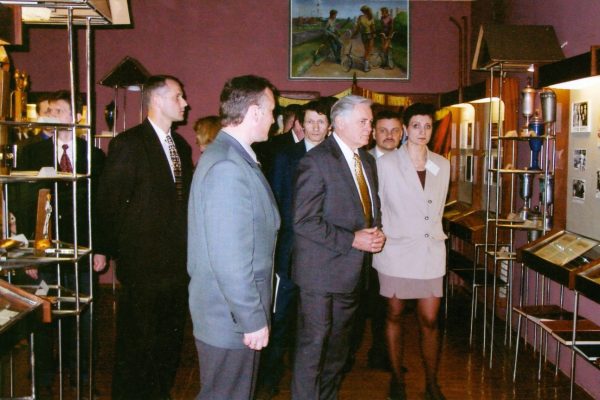
In 2004, Valdas Adamkus was awarded the title of Honorary Doctor of the Lithuanian Sports University, then known as the Lithuanian Academy of Physical Education (LKKA).
The President particularly enjoyed meeting and engaging with students. During one such meeting, he spoke in detail about his international activities as UNESCO Goodwill Ambassador for the Construction of Knowledge Societies.
President Adamkus subsequently participated in several academic events organised by our University.
On 25 October 2012, he attended an LSU conference commemorating the 75th anniversary of Lithuania’s victory at the 1937 European Basketball Championship.
On 23 May 2016, he also participated in the conference The History and Future Vision of World Lithuanian Sport, held at LSU.
Key Biographical Facts
Valdas Adamkus was born on 3 November 1926 in Kaunas, into a family of civil servants.
Before the Second World War, he attended J. Jablonskis Primary School and Aušra Boys’ Gymnasium.
During the war, he actively participated in the resistance movement against the Nazi and Soviet occupiers. After the war, he was involved in activities in displaced persons camps in Germany. He completed his secondary education at a school for war refugees in Eichstätt, Germany.
In 1949, Adamkus emigrated to the United States, where he married Alma Nutautaitė in 1951.
In 1961, he graduated from the Illinois Institute of Technology with a degree in civil engineering.
In 1971, he began working for the United States federal environmental protection authorities, becoming Deputy Administrator of the Environmental Protection Agency’s Region 5 and, in 1981, its Regional Administrator.
Throughout his years in the United States, Adamkus remained actively involved in Lithuanian diaspora organisations. He is regarded as one of the founders of the Lithuanian cultural organisation Santara-Šviesa.
Following the restoration of Lithuania’s independence, Adamkus became actively involved in rebuilding the Lithuanian state.
In 1993, he headed the election campaign of Stasys Lozoraitis, who was running for President of Lithuania.
In 1998, Valdas Adamkus was elected President of the Republic of Lithuania.
In 2002, he ran for re-election but lost to Rolandas Paksas in the second round.
In 2003, he was appointed UNESCO Goodwill Ambassador for the Construction of Knowledge Societies, and in 2015 he became Ambassador of World Lithuanian Sport.
In 2004, following the Lithuanian Parliament’s decision that then-President Rolandas Paksas had violated the Constitution and his subsequent removal from office, Adamkus was elected President of the Republic of Lithuania for a second time.
Following the end of his second presidential term, Adamkus has remained involved in Lithuanian and international non-governmental and public organisations.
Happy 100th Birthday, President Valdas Adamkus!
Article prepared by Saulius Kavaliauskas, Lecturer at the Lithuanian Sports University.
Photos: Archives of the Lithuanian National Olympic Committee (LNOC), Lithuanian Sports University (LSU), and personal archives.