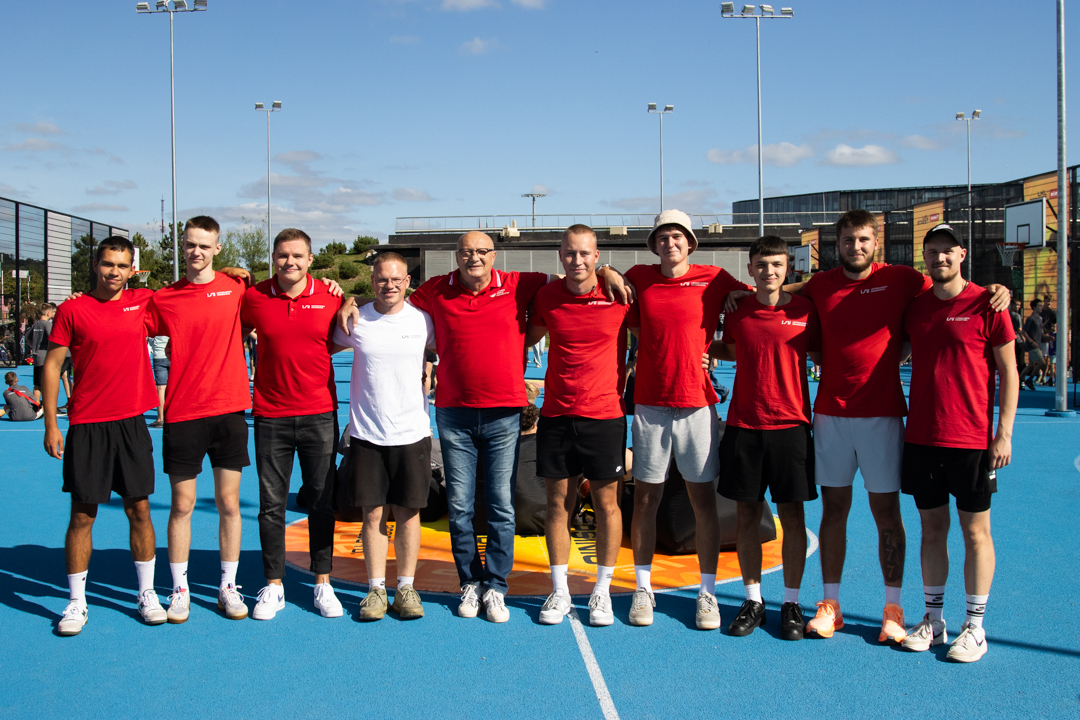
While most of us use the summer to slow down and take a break, the most ambitious people in the world of sport see it as an opportunity for individual development. For students specialising in basketball at Lithuanian Sports University (LSU), summer has become a continuous cycle of professional growth.
Martynas Paltanavičius and Liucijus Biekša are two young basketball specialists who have already gained valuable experience this year through internships with the Real Madrid basketball organisation. During the summer, alongside leading intensive training sessions as part of the LKL Street x Rimi project, they are also working with young players in individual skills sessions.
Their experiences highlight the demands of modern coach education: a coach must be more than a tactician. Today’s basketball specialist must also be a psychologist, a technology expert and a leader capable of building a strong community.
LSU’s Coaching Systems study programme has long moved beyond the boundaries of theoretical textbooks, becoming something of a basketball laboratory. Both students emphasise that the university’s approach to education is based on continuity – from fundamental knowledge during the first year to deeper specialisation in the final years of study.
Martynas Paltanavičius remembers the beginning of his studies, when every element – from correct shooting technique to defensive rotations – was broken down into the smallest details.
“We didn’t just learn how to perform an exercise – we also became each other’s coaches. During classes, one student is given a topic and leads a training session, after which the entire group, together with the lecturers, analyses what worked, what was ineffective and how the same information could be presented better. This develops critical thinking and the ability to accept feedback,” says Martynas.
Liucijus Biekša, who is about to begin his fourth year, stresses that the real value of his studies lies in the integration of theory and practice. In his view, basketball specialists cannot afford to be mere theoreticians. Knowledge of human anatomy, physiology and movement control acquired at university is immediately put into practice on the court.
“At LSU, we learn to understand a player as both a biological and psychological system. For example, if a player repeatedly makes the same mistake when shooting, we look for the reasons not only in technique but also in biomechanics. This allows a coach to become much more precise,” explains Liucijus.
Both students consider their cooperation with the Snaiperio Academy particularly valuable. Its director, Kęstutis Matulaitis, gives students the opportunity to coach children, allowing them to experience the realities of working on the court.
The influence of their mentor, coach Ramūnas Butautas, also plays a special role in shaping their coaching philosophy. According to Martynas Paltanavičius, the experienced basketball coach emphasises that coaching goes far beyond drawing plays on a board. It is also a process of shaping personalities.
Butautas often challenges students to think about culture, history and art, stressing that broad knowledge and intellectual curiosity are inseparable from the qualities of a charismatic leader.
“If you want to inspire a player, you have to be an authority not only in basketball but also in life. The ability to communicate with administrators, parents or the media is just as important as scouting,” says Martynas, recalling his mentor’s lessons.
Learning to Coach Through Real-Life Experience
During the summer, the students’ activities move to the courts of the LKL Street x Rimi project. For young coaches, the project becomes a unique test of patience, communication and adaptability.
Instead of professional athletes, they work with local communities, children and basketball enthusiasts whose motivation and skills can vary greatly. Liucijus Biekša describes this as the ultimate “school of adaptation”.
“In one training session, you can have a six-year-old child who is holding a basketball for the first time and a grandfather or mother who simply wants to have a good time. Within a few minutes, you have to change your tone of voice, the complexity of the exercise and your communication style. It develops emotional intelligence incredibly well,” he says.
Martynas Paltanavičius approaches coaching as a form of educational mission. For him, LKL Street x Rimi is a platform where children can be inspired to take up sport at a time when they have countless alternatives offered by technology.
“It’s not enough to tell children, ‘Do it this way.’ They ask, ‘Why?’ If, as a coach, you can explain the details to them – how to position their foot, why hand position matters when shooting – they see the result and become excited. That is the greatest reward for a coach,” Martynas says.
Both students agree that LKL Street is about much more than basketball. It is about values – respect, teamwork and the confidence to make mistakes and learn from them. Liucijus adds that the coach becomes a role model who helps young people develop confidence both on and off the court.
A First-Hand Look at the Future of Basketball
One of the students’ most memorable recent experiences was their visit to the Real Madrid basketball organisation. The trip offered them a first-hand look at the direction in which modern basketball is developing.
For Martynas Paltanavičius, the Spanish approach to player development was particularly impressive.
“At the Real Madrid Academy, the goal is not quantity. They train in a huge complex where basketball and football operate under the same roof, but every player receives individual attention. What is particularly interesting is that in youth competitions, players receive equal playing time. This ensures that every talent has a real opportunity to apply what they have learned in training,” he says.
Liucijus Biekša, who is particularly interested in the use of technology in sport, saw what he considers a glimpse of the future of basketball in Madrid.
“At LSU, we have classes on technology, and coach Ramūnas Butautas uses video analysis in real time, but at Real Madrid this is taken to another level. Their physiotherapists use Kinexon systems – special sensors integrated into vests that transmit data on players’ workloads in real time. This allows the intensity of training to be adjusted immediately, helping to protect players from injuries. Even more impressive is that during games, footage is edited in real time, so players can already see clips of their mistakes during half-time,” Liucijus explains.
The students are already incorporating ideas from their visit into their own work, particularly those related to rapid decision-making and the distinctive Spanish approach to basketball.
According to them, the most important lesson from sunny Madrid is that professionalism begins with the smallest details, while technology in modern sport is no longer a luxury but an essential tool for achieving maximum performance.
A Pathway to Professional Basketball
LSU studies and summer projects are becoming a springboard into professional basketball.
As the new season approaches, Liucijus Biekša is taking on a major challenge: he will join the coaching staff of Kėdainiai Nevėžis-Paskolų klubas. His new role demonstrates that modern basketball clubs increasingly value young, ambitious specialists equipped with both practical experience and scientific knowledge.
“The opportunity to work for such a club while still studying is an incredible responsibility. I want to be a ‘sponge’ that absorbs as much experience as possible from my more experienced colleagues – from the subtleties of scouting to the psychology of team management,” says Liucijus, who will work alongside head coach Evaldas Beržininkaitis.
He will join an already strong LSU presence in the Betsson LKL, with more than half of the league’s head coaches having studied at LSU, not to mention their assistant coaches and strength and conditioning specialists. In addition, LSU students are gaining practical experience with six LKL teams as they prepare for the upcoming season.
Martynas Paltanavičius, meanwhile, plans to begin working with LSU’s senior basketball team in the autumn, where he hopes to serve as a bridge between the principles of university basketball and professional sport.
Both students agree that becoming a coach is a journey of continuous evolution. Rather than looking for quick success, they are focused on consistent development, combining the scientific foundation provided by LSU with practical experience on the court.
Their message to future coaches is clear: basketball is much more than a game played with a ball. It is about continuous self-improvement, curiosity and the ability to learn from every situation.
The lessons learned through LKL Street x Rimi, visits to international clubs and discussions with experienced mentors all contribute to developing specialists who are ready to lead their teams towards success.
LKL information