I am text block. Click edit button to change this text. Lorem ipsum dolor sit amet, consectetur adipiscing elit. Ut elit tellus, luctus nec ullamcorper mattis, pulvinar dapibus leo.
LSU launches Europe’s first university-based basketball referee training program
2026 03 02
Basketball is not just players and coaches, tactical plans and the fight for every inch of the court. It is also referees’ decisions – decisions that disappoint some and give hope to others. Top-level competitions are unimaginable without professional officiating.
Lithuanian Sports University (LSU), consistently expanding its fields of study and strengthening ties with the sports community, is taking a new step: together with the Lithuanian Basketball Referees Association (LKTA), it is launching a unique Basketball Referee Training Program- one of a kind in Europe.
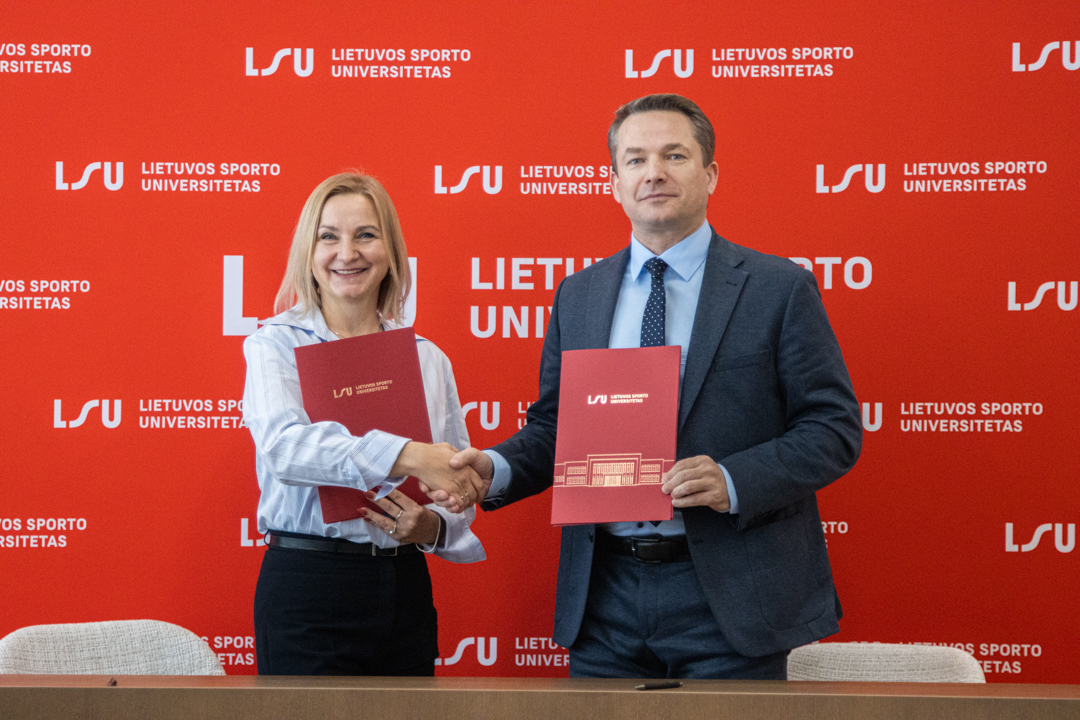
The cooperation agreement was signed by LSU Rector Prof. Dr. Diana Rėklaitienė and LKTA President Tomas Jasevičius. Also attending the event were LKTA presidium members Juozas Barkauskas and Kęstutis Pilipauskas, as well as Head of the LSU Basketball Studies and Research Center Ramūnas Butautas.
LSU is the first sports university not only in the Baltic States but also in Europe to systematically train basketball referees on an academic basis. Until now, referee training has most often taken place in schools or courses organized by the association, but from now on this activity will be integrated into university studies.
According to R. Butautas, the idea had been developed over several years, and this year a pilot model of the program demonstrated clear benefits. Students from all years of the basketball specialization took part, and some of them have already started officiating in school and amateur leagues.
“Our goal is to educate a modern, well-rounded coach. That is why we have included not only youth, 3×3, or professional team assistant training in the study program, but also referee preparation,” emphasized R. Butautas.
From September, the program will be implemented consistently and systematically. Students will be taught by experienced, internationally certified referees, and the program will be led by J. Barkauskas. Officiating studies will help future coaches better understand game management as well as psychological and tactical nuances. At the same time, it opens an alternative professional path- some students may choose a refereeing career or combine both roles.
“One of the most important goals of the program is to strengthen mutual understanding between coaches and referees. Basketball coaches must have an excellent knowledge of the rules and understand the logic of officiating,” stressed LKTA President T. Jasevičius.
Lithuanian basketball has historically been known for high-level referees: from the interwar period to today, more than thirty Lithuanian officials have earned international-category status. At present, three Lithuanians officiate in the EuroLeague, which testifies to the high level of the country’s specialists.
Nevertheless, according to T. Jasevičius, there is a shortage of referees in the regions and in youth competitions. Young people often leave to study in larger cities, creating gaps in smaller towns.
The new program can become a long-term solution: students who acquire competencies during their studies will be able to officiate while studying and later, after returning to their hometowns, work as coaches or physical education teachers. Cooperation between LSU and LKTA also opens opportunities for the development of sports science. As R. Butautas noted, there are still many unexplored topics in officiating—from the psychology of decision-making to physical preparation and match analysis.
A university environment will create conditions for scientific research, the results of which can be applied in practice and contribute to improving the quality of officiating. LSU Rector D. Rėklaitienė emphasized that the university seeks close cooperation with sports federations and associations so that students can enter sports practice as early as possible.
“We want our students to gain competencies already during their studies that provide broader professional opportunities. Some will become coaches, others teachers, and others referees. The most important thing is that they remain within the sports system and strengthen Lithuanian sport,” the rector stated.
Basketball is changing rapidly – technology and game dynamics are evolving – so the refereeing profession requires continuous development. It is expected that the new LSU and LKTA program is a step toward systematic, academically grounded referee training, which could become an example for other European countries as well.